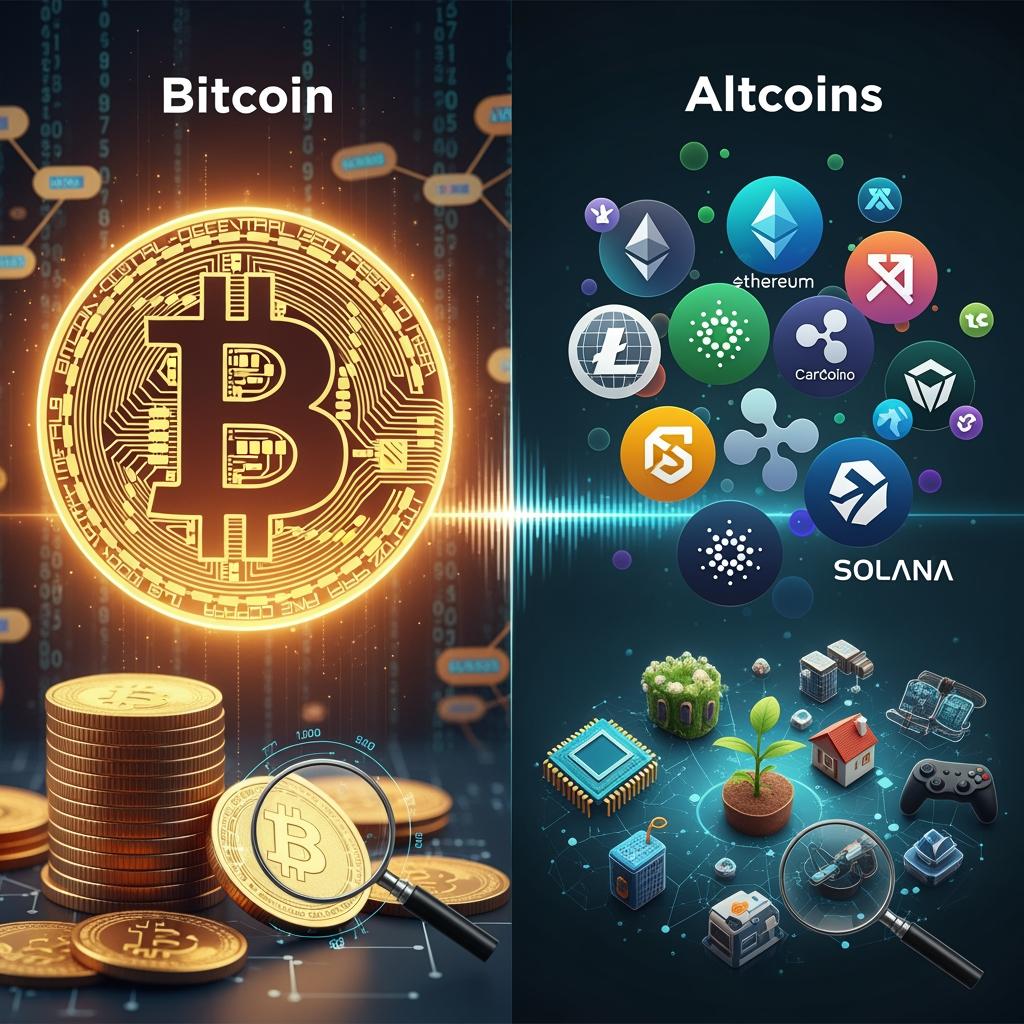

There is a moment almost everyone in the crypto world remembers, when they first heard the word Bitcoin and wondered if it was some kind of video-game money. For many people, that was somewhere between 2012 and 2017, when the world suddenly began paying attention to this strange digital asset that was not issued by any government. Some ignored it. Some laughed at it. A few bought it and changed their lives forever.
Then something interesting happened. New digital currencies began to appear. Not one or two, but hundreds… then thousands. They promised faster transactions, different systems, new technologies, and in some cases, bigger dreams than Bitcoin itself. These new coins were eventually called altcoins, short for alternative coins.
Today, if you try to dive into the crypto market without understanding the difference between Bitcoin and altcoins, the experience can feel like walking into a busy market without knowing what you came to buy. There is noise, excitement, suspicion, opportunity, and more options than one person can process.
This guide exists to make that world simpler and clearer. By the time you reach the final sentence, you will understand:
- What makes Bitcoin unique
- What altcoins are truly about
- Why some altcoins succeed and others fail
- How both categories shape the future of digital money
- And how an average person can think about them in 2025 without confusion
So let’s begin from the foundation.
Bitcoin
Bitcoin is like the original reference point, the first successful cryptocurrency in history. It was introduced in 2009 by a mysterious figure known as Satoshi Nakamoto, who wrote a whitepaper describing a peer-to-peer digital currency that does not require banks, governments, or middlemen.
To appreciate its importance, think about how many times we send money and how often banks stand in between, controlling fees, delays, and rules. Bitcoin challenged this model and said, “What if people could exchange value directly, anywhere in the world, without permission from anyone?”
That idea changed global finance.
Key Traits of Bitcoin
| Feature | Meaning (Human Explanation) |
| Store of Value | Many treat Bitcoin like digital gold, an asset to preserve wealth over time. |
| Limited Supply | Only 21 million bitcoins will ever exist, making it resistant to inflation. |
| Decentralized | No government or company owns Bitcoin. It is powered by a global network of computers. |
| Most Secure Blockchain | It has the longest and most battle-tested blockchain in crypto history. |
When you look at the top-tier markets: US, UK, Canada, Germany, Singapore, UAE, Bitcoin has become a recognized digital asset for long-term investment. Major corporations hold it on their balance sheets. Some funds treat it as a hedge against monetary uncertainty.
It may be digital, but in the world of crypto, Bitcoin is the closest thing to a blue-chip asset.
Altcoins
If Bitcoin is the oldest child, altcoins are the children who came after, each with their own personality and ambition.
The simplest definition:
Altcoins are any cryptocurrencies that are not Bitcoin.
Some altcoins try to improve on Bitcoin’s limitations. Others are focused on completely different goals. And many, if we are being honest, may not survive the test of time.
Just like startups, not every idea becomes a success.
Categories of Altcoins (2025 Reality)
| Type of Altcoin | Example Use Case |
| Smart Contract Platforms | Ethereum, Solana, Avalanche—support decentralized apps |
| Payment Coins | Litecoin, XRP—faster or cheaper transactions |
| Stablecoins | USDT, USDC—coins tied to the value of the US dollar |
| DeFi Tokens | Uniswap, Aave—finance without banks |
| Gaming & Metaverse Tokens | Sandbox, Decentraland—digital worlds and assets |
| AI/Crypto Fusion | Fetch.ai, Render—AI and blockchain combined |
Some altcoins represent real innovation, like Ethereum, which introduced smart contracts, the digital agreements that execute automatically. This idea created entirely new industries such as DeFi and NFT markets.
Others, however, are designed with short lifespans, hyped marketing, and little purpose. And that leads us to a critical truth:
Not every altcoin is a meaningful project, and not every quick gain is a wise investment.
How Bitcoin and Altcoins Differ (Beyond Definitions)
It is easy to list technical differences, but the real distinctions are philosophical and practical.
1. Purpose and Vision
- Bitcoin aims to be decentralized digital money and a secure store of value.
- Altcoins explore multiple missions. Faster payments, smart contracts, privacy, gaming, AI, tokenized ownership, data storage, and more.
Bitcoin is focused. Altcoins experiment.
2. Supply and Inflation
Bitcoin’s supply is fixed at 21 million coins.
Altcoins often have flexible supply models. Some increase supply gradually. Others burn tokens to reduce supply.
3. Market Perception
Bitcoin has entered the world’s financial consciousness. It has crossed from tech culture into mainstream investment.
Altcoins still fight for recognition. Some succeed brilliantly. Others fade quietly.
4. Risk Profile
Bitcoin is volatile, but altcoins can be dramatically more volatile. You might see +200% in a month… and –60% in the same month.
Investors often treat Bitcoin as a strategic asset and altcoins as speculative opportunities.
Real-World Examples: How They Function Differently
Bitcoin as Digital Gold
A US-based investment firm allocates part of its treasury to Bitcoin. They are not trying to use it for daily transactions. They hold it the same way they hold gold for long term, with patience.
Ethereum (Altcoin) as a Digital Economy
A developer in Canada builds an application that allows artists to sell music directly to fans without streaming platforms. Transactions run on Ethereum smart contracts.
Solana (Altcoin) and Speed
A gaming company in Singapore builds a multiplayer game where players earn and trade assets on Solana because it processes transactions faster than most blockchains.
Why Altcoins Exist at All (If Bitcoin Came First)
Because innovation rarely stops at version one. Airplanes came after trains. Smartphones came after rotary phones. And in technology, younger systems often learn from older ones.
Bitcoin opened the door. Altcoins walked in with different questions:
- Can transactions be faster?
- Can the blockchain run complex applications?
- Can digital assets represent real-world ownership?
- Can blockchain support AI, virtual economies, and decentralized finance?
Some altcoins attempt to solve problems Bitcoin was never designed to solve.
A Balanced Way to Think About Them (Not Hype, Not Fear)
A simple framework many global investors use:
| Asset Type | Typical Role |
| Bitcoin | Long-term store of value and hedge asset |
| Major Altcoins (ETH, SOL, AVAX) | Technology and innovation exposure |
| Emerging Altcoins | High risk, high uncertainty, potential short-term opportunities |
Different assets, different expectations, different time horizons.
How Beginners Can Approach Crypto Wisely in 2025
1. Learn before investing.
Understanding is protection.
2. Be clear about your risk tolerance.
Not everyone needs to chase every new token.
3. Diversify with intention.
Some combine Bitcoin for stability and select altcoins for innovation.
4. Focus on real utility.
If a project solves no real problem, duration becomes a question.
The Future: Can Altcoins Overtake Bitcoin?
Some believe yes. Some believe no, but one truth stands:
Bitcoin has historical significance and unmatched security. Altcoins have flexibility and evolving innovation.
The future may not be a competition but an ecosystem where:
- Bitcoin is digital value preservation
- Altcoins power digital economies and applications
Final Reflection
Bitcoin changed how humanity thinks about money. Altcoins expanded that vision into how we might live, work, play, create, and interact in a digital world. We are still early in this transformation, and thoughtful participation matters more than speed.
If Bitcoin is the origin, altcoins are the exploration. One gives foundation, the other gives possibility