
You’ve been hearing the word altcoins flying around like confetti at a crypto wedding. Somebody on X (formerly Twitter) is shouting, “This altcoin will be 10x!” Your colleague in New York just told you he bought one coin that sounds like a cartoon character. Meanwhile, you’re there asking yourself, “Wait… is this thing even legal? And what exactly is an altcoin?”
Calm down. Carry your chair. Let’s break it down. Because if you’re in some countries especially the Tier 1 countries where regulators actually wake up early, you can’t afford to just throw money into anything with a rocket emoji.
Let’s start from the beginning.
When people say “altcoins,” what they mean is simple. It literally means “alternative coins.” Alternative to what? To Bitcoin. Everything that is not Bitcoin is, by definition, an altcoin. That includes big names like Ethereum and even the funny ones like Dogecoin. If it’s not Bitcoin, it’s an altcoin. But that definition is too simple. And crypto is never just simple.
So let’s go deeper.
Back in 2009, Bitcoin entered like that quiet genius in class who doesn’t talk much but always tops the exam. It introduced blockchain technology, decentralized money, no banks in the middle. People saw it and said, “Ah! This thing is powerful. But can we improve it?” That’s how altcoins were born.
Some altcoins tried to make transactions faster. Some tried to reduce fees. Some wanted smart contracts. Some just wanted vibes and memes. Now here’s where it gets interesting. Altcoins are not one big family. They are like cousins, same bloodline, but different personalities. Let me show you properly.
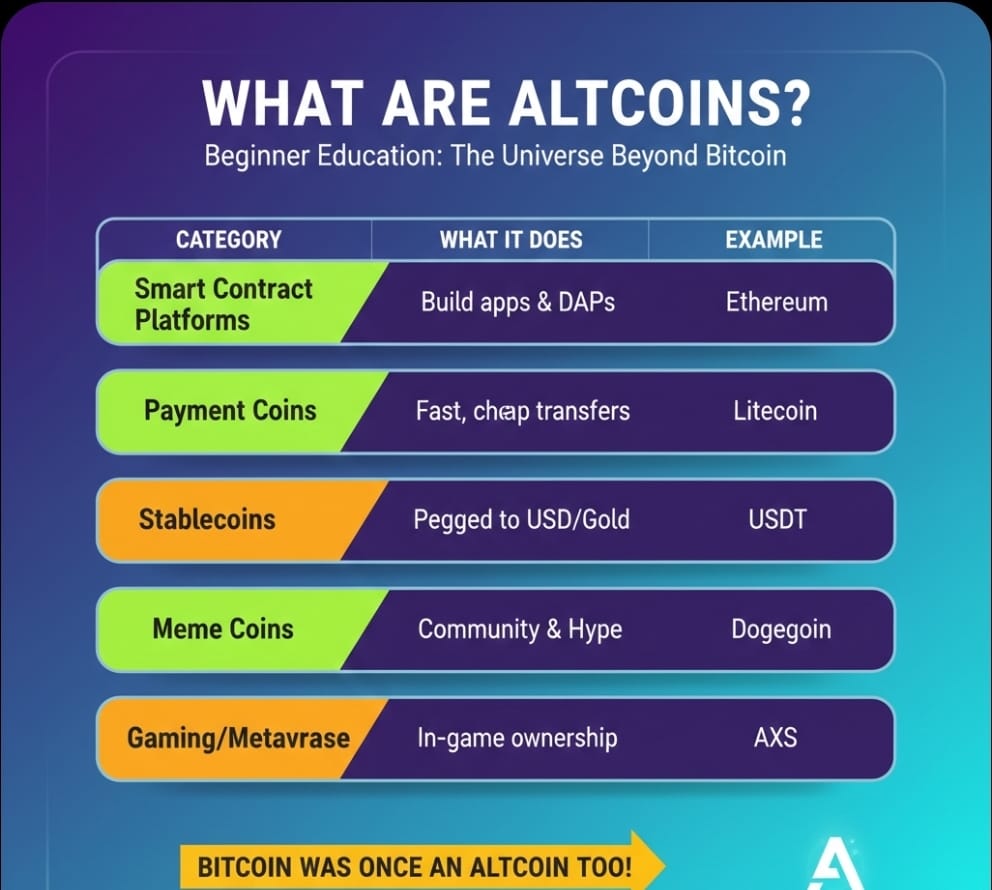
Below is a simple breakdown so you don’t mix things up.
| Category | What It Does | Example | Why It Exists |
| Smart Contract Platforms | Allow developers to build apps on blockchain | Ethereum | To go beyond simple payments |
| Payment Coins | Focus on fast, cheap transactions | Litecoin | Improve speed & cost of transfers |
| Stablecoins | Pegged to stable assets like USD | USDT | Reduce volatility |
| Meme Coins | Community-driven, hype-based | Dogecoin | Culture, speculation |
| Utility Tokens | Used inside specific ecosystems | BNB | Power a platform’s services |
| Gaming/Metaverse Tokens | Used in blockchain games | AXS | Digital ownership in games |
Now look at that table carefully.
You see that altcoins are not just random coins. Many actually solve specific problems.
Take Ethereum for example. It introduced smart contracts. That means developers can build decentralized apps from lending platforms to NFT marketplaces, all without traditional banks.
If Bitcoin is digital gold, Ethereum is more like digital infrastructure. Then you have stablecoins. These ones are calm. They don’t fluctuate like others. A coin like USDT is tied to the US dollar. So one USDT is roughly one dollar.
People in America use it for trading. People in Africa use it to escape currency instability. People everywhere use it when they want to sit out volatility without exiting crypto completely. Then come meme coins. These ones are the wild children of the family.
Dogecoin started as a joke. Literally a meme. But because the community is powerful, especially online, it became a billion-dollar asset at one point. Crypto is half technology, half psychology. Don’t ever forget that.
Now let’s address the real question beginners are afraid to ask:
Are altcoins better than Bitcoin?
The honest answer? It depends.
Bitcoin is the most established. It has the strongest brand recognition. Institutions like it because it feels safer.
Altcoins, however, offer higher potential growth. But with higher potential growth comes higher risk.
If Bitcoin drops 10%, some altcoins can drop 30% in the same week. And if Bitcoin rises 20%, some altcoins might jump 100%. This is not investment advice, it's reality.
Volatility is the price you pay for opportunity. Now let’s talk about why beginners get confused.
Most people enter crypto during bull markets. That’s when everybody is making money. Even your Uber driver is giving coin recommendations. During that time, altcoins look like magic. But when the market turns red? That’s when you find out who was swimming naked. Many altcoins don’t survive bear markets. Projects disappear. Developers vanish. Liquidity dries up.
That is why research is not optional. If you live in a Tier 1 country, regulators are watching crypto closely. The SEC in the US, FCA in the UK, they are not joking around. Some altcoins may later be classified as securities. That can affect availability on exchanges. So you must pay attention to legal developments in your region. Crypto is global. But regulation is local. Another thing beginners don’t understand is market capitalization.
Price alone means nothing. A coin can be $0.01 and still be expensive if the supply is massive. Always check the market cap. That tells you the overall value of the project. And please, don’t just buy because someone on YouTube said “100x incoming.”
Many influencers earn from promoting coins. Some are honest. Some are not. If you wouldn’t take random medical advice from TikTok, why would you take financial advice without research? Let’s talk about risk management. Never invest money you cannot afford to lose.
Crypto is still experimental. Yes, it’s growing. Yes, institutions are entering. But it’s not guaranteed. Diversification matters. Some people hold mostly Bitcoin and sprinkle small percentages into altcoins. Some go heavy on altcoins during bullish cycles. Strategy depends on your risk tolerance. If you lose sleep when your portfolio drops 15%, altcoins might not be your best friend.
If you understand volatility and can stomach drawdowns, then you might explore them carefully. Now let me say something clearly.
Altcoins are not scams by default.
But scams exist inside the altcoin world.
There are legitimate projects solving real problems. There are also copy-paste tokens created in five minutes designed to pump and dump..How do you tell the difference?
Look at the team. Is it public?
Look at the use case. Does it solve a real problem?
Look at community engagement. Is it organic or bot-driven?
Look at tokenomics. Who holds most of the supply?
If 80% is held by insiders, that’s a red flag waving like a political campaign banner. One more thing beginners ignore: liquidity. If you can’t easily sell your coin, you don’t own an investment. You own hope and hope is not a strategy.
Now let’s zoom out.
Altcoins represent innovation. Faster chains. Smarter contracts. Decentralized finance. NFTs. Gaming economies.
They are experiments, so, some will fail and some will evolve. Some might reshape industries. That’s why education matters more than hype. If you’re in New York, London, Toronto, Sydney wherever you are treat crypto like venture capital, not a savings account.
Learn before you leap.
Start small.
Track your portfolio.
Understand cycles.
And remember this simple truth:
Bitcoin started as an altcoin too. Every giant was once small, but not every small project becomes a giant.
So when someone asks, “What are altcoins?” don’t just say, “Everything except Bitcoin.”
Tell them it’s a universe. A chaotic, innovative, risky and fascinating universe. Some parts are gold mines. Some parts are landmines. The difference between the two is knowledge. And now, at least, you’re no longer walking in blind.