
Let’s not pretend. If you’ve spent more than five minutes in any crypto space, whether you’re in New York sipping overpriced coffee, in London dodging grey skies, in Toronto checking your TFSA, or in Sydney pretending your rent is normal, you’ve heard this debate.
“Bitcoin is king.” “Altcoins will outperform.” “Everything except Bitcoin is a scam.” “Bitcoin is old tech.”
So let’s sit down and talk properly because when money is involved, it's very important.
First, Understand the Foundation
Bitcoin is the first successful decentralized cryptocurrency was launched in 2009 and introduced the idea that money doesn’t need a central authority. That alone changed finance forever.
Altcoins simply mean “alternative coins.” Everything that isn’t Bitcoin falls into this category. And I mean everything. From serious infrastructure to high-speed networks to community-driven assets .
If Bitcoin is the father, altcoins are the children. Some are geniuses. Some are rebellious. Some are well and some are questionable.
The Core Difference: Store of Value vs Utility Playground
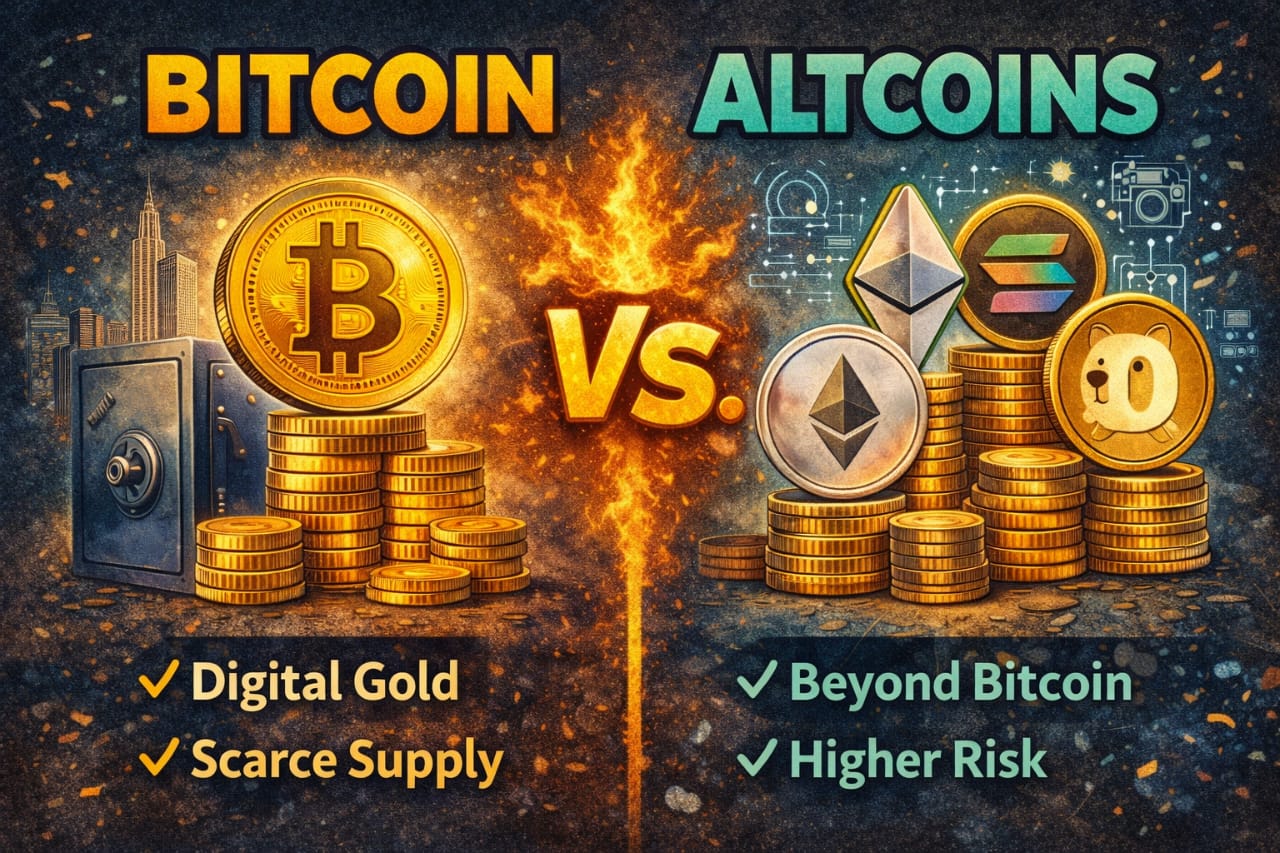
Let’s simplify it. Bitcoin’s main narrative is “store of value.” It's called the digital gold. It has limited supply, only 21 million coins. That’s why institutions, hedge funds, family offices, even some publicly traded companies are comfortable allocating to Bitcoin. It’s predictable in its unpredictability.
Altcoins? It's a whole different energy. Most altcoins exist to do something. Ethereum introduced smart contracts. That changed everything. Suddenly, developers could build decentralized applications on a blockchain.
Solana focused on speed and lower transaction fees. Some altcoins focus on gaming. Some on DeFi. Some on privacy. Some on interoperability. Bitcoin is relatively simple in its purpose. Altcoins are experimental laboratories. That’s the first major difference.
Volatility: Who Gives You Sleepless Nights?
Let’s talk about risk. Bitcoin is volatile. Don’t let anybody lie to you. It can drop 20% in a week and still be called “stable” by crypto standards.But compared to altcoins? Bitcoin looks calm.
Altcoins can move so fast. During bull markets, altcoins often outperform Bitcoin dramatically. You’ll see 50%, 100%, even 300% moves in short periods.
During bear markets? That same coin can lose 80% of its value and pretend nothing happened. Bitcoin is considered the safer bet in crypto. Altcoins are higher risk, higher potential reward.
Institutional Acceptance
Let’s be realistic. Regulators in the US, UK, and Canada are not playing games with crypto anymore. Bitcoin has achieved a level of institutional legitimacy that most altcoins have not. Major asset managers have launched Bitcoin-related investment products. Public companies have added Bitcoin to their balance sheets.
Altcoins, on the other hand, are still navigating regulatory gray zones. Some may be classified as securities. That changes how they’re traded and where they’re listed. If you’re a cautious investor in a highly regulated market, this distinction is important. Bitcoin is closer to being treated like a commodity. Many altcoins are still in regulatory limbo.
Network Effects: The Power of Being First
Bitcoin has the strongest network effect in crypto. Most secure network. Largest market capitalization. Most recognized brand. Even people who don’t understand blockchain know the name Bitcoin. That brand power matters.
Altcoins, however, compete with each other constantly. New projects launch every year claiming to be “faster,” “cheaper,” or “more scalable.” Some succeed and many fade.
Bitcoin doesn’t compete the same way. It occupies its own category. Digital gold doesn’t need to update its feature list every quarter.
Technology and Innovation
Here’s where altcoins shine. Bitcoin’s development is conservative by design. Changes are slow and heavily debated.
Altcoins move faster. Ethereum transitioned to proof-of-stake. Other networks experiment with new consensus models. Some chains process thousands of transactions per second. Innovation is happening mostly in altcoin ecosystems. Decentralized finance (DeFi), NFTs, blockchain gaming. These grew largely outside Bitcoin’s core network.
If you’re interested in the technological frontier of crypto, altcoins are where most experimentation happens. Bitcoin focuses on security and decentralization. Altcoins explore scalability and functionality.
Supply Dynamics
Bitcoin has a fixed maximum supply: 21 million. That scarcity narrative is powerful. Many altcoins do not have fixed supplies. Some are inflationary. Some burn tokens over time. Some adjust issuance rates. Tokenomics varies wildly and tokenomics affects price behavior. If a coin constantly increases supply without increasing demand, price pressure builds downward.
Bitcoin’s predictable issuance schedule creates a clear economic model. Altcoins require deeper research. You can’t just look at the price. You must understand supply mechanics.
Community Culture
This part is underrated. Bitcoin has a very strong ideological community. Many holders believe in it almost philosophically. Decentralization. Financial sovereignty. Anti-inflation stance.
Altcoin communities are diverse. Some are developer-focused. Some are trader-focused. Some are meme-driven. Community strength often determines survival. A weak community during a bear market? That project may not recover. Bitcoin’s community has survived multiple crashes. That resilience matters.
Risk Management
If you’re investing from a country with strong regulatory oversight and structured tax systems, strategy matters. Bitcoin is often treated as a long-term allocation. Altcoins are usually shorter-term plays or smaller portfolio percentages. Many experienced investors use a core-satellite strategy: Core holding: Bitcoin. Satellite positions: Select altcoins.
Why?
Because Bitcoin provides relative stability within crypto. Altcoins provide growth potential. So, balance is everything.
Performance Cycles
Crypto moves in cycles. During early bull markets, Bitcoin often leads the rally. Later in the cycle, capital flows into altcoins. This is sometimes referred to as “alt season.” But here’s the truth: not every altcoin participates. Some surge, some lag while some disappear. Timing matters more with altcoins than with Bitcoin. Bitcoin tends to recover historically after downturns. Altcoins don’t all share that recovery guarantee.
A Simple Comparison Snapshot
Let’s lay it out clearly:
| Factor | Bitcoin | Altcoins |
| Origin | First cryptocurrency | Alternatives to Bitcoin |
| Main Narrative | Store of value | Utility, innovation, experimentation |
| Volatility | High | Very high |
| Institutional Adoption | Strong | Limited but growing |
| Supply Model | Fixed (21M) | Varies by project |
| Regulatory Clarity | Higher | Mixed |
| Risk Level | Lower (within crypto) | Higher |
Notice something?
This isn’t about good versus bad.
It’s about purpose and risk profile.
So Which Is Better?
Wrong question. Better for what?
If your goal is long-term wealth preservation within crypto exposure, Bitcoin often makes sense. If your goal is aggressive growth and you understand volatility, selected altcoins might offer opportunity. But blind speculation? That's a bit angerous. Crypto markets are efficient at punishing emotional decisions. Especially in competitive financial environments like the US and UK, where tax implications and capital gains reporting are real, you cannot treat this casually.
Education beats hype.
The Psychological Factor
Let me tell you something honest. Altcoins feel exciting. New launches. Big promises. Community buzz. Bitcoin feels boring by comparison. But boring can be profitable. Many investors underestimate how much psychology drives decision-making. Chasing 10x returns can blind you to downside risk. Sometimes slow and steady is not glamorous, but it builds wealth.
Final Thought
Altcoins versus Bitcoin is not a boxing match. It’s portfolio strategy..Bitcoin provides foundation altcoins provide expansion. If you’re serious about crypto, especially in highly developed financial markets, your approach must be intentional. Research deeply, diversify wisely and understand the risk. Respect volatility. Crypto rewards patience, it punishes arrogance. And whether you choose Bitcoin, altcoins, or a mix of both, the most important asset you can hold is knowledge. Because in this market, ignorance is expensive.